
Ottawa’s outdoor season is short. From the last frost to the first hard freeze, you have roughly five months and even within that window, the evenings close in fast. By mid-August the sun sets before eight. By October, darkness arrives well before dinner is finished.
Most properties simply go dark at that point. Patios sit empty, gardens disappear, and hours of potentially comfortable outdoor living are given up without a second thought. Landscape lighting is one of the most direct ways to reclaim that time.
A well-designed lighting scheme extends the functional hours of your outdoor spaces through autumn, keeps your property looking maintained year-round, and adds a layer of security that passive installations cannot match. It is also one of the few outdoor investments that performs across all four seasons not just the warm months that justify most of the spend.
This post covers what thoughtful landscape lighting looks like in an Ottawa context: what it does, what it involves, and why the planning decisions you make early have an outsized effect on the result.
Why Ottawa Properties Benefit Differently From Lighting Design
Landscape lighting is a standard offering in most markets, but Ottawa’s conditions create a specific set of demands that affect how it should be designed and installed.
The freeze-thaw cycle is the defining factor. Between November and April, ground temperatures move above and below zero repeatedly sometimes multiple times in a single week. This movement affects:
-
Conduit runs beneath paved surfaces, which can shift or crack if not set at the correct depth and with appropriate expansion consideration
-
Fixture mounting hardware, particularly in mortar joints or at grade level, where repeated cycling loosens anchors over time
-
Sealed fixture housings, where temperature differentials create pressure changes that degrade seals and allow moisture infiltration
None of these issues are insurmountable, but they require installation practices that account for local conditions rather than simply following a generic approach. A lighting system that works reliably in Vancouver or Toronto may not hold up the same way here without those adjustments.
The other Ottawa-specific reality is the length of the dark season itself. From November through March, your property is visible after dark for far more hours than it is in daylight. Lighting that reads well that frames the house, marks the entry, and gives the garden some presence matters more here than in cities where winter evenings are simply shorter.
Neighbourhoods like Rockcliffe Park, Westboro, Manotick, and The Glebe have seen consistent investment in outdoor living over the past decade. In these areas, landscape lighting has become a baseline expectation for a well-considered property, not an upgrade. The standard has shifted, and the gap between lit and unlit properties after dark is increasingly noticeable.
What Good Landscape Lighting Actually Does
There is a tendency to think of landscape lighting as decorative something added at the end to make a property look nice at night. In practice, a well-designed scheme serves three distinct functions, and the most effective installations hold all three in balance.
-
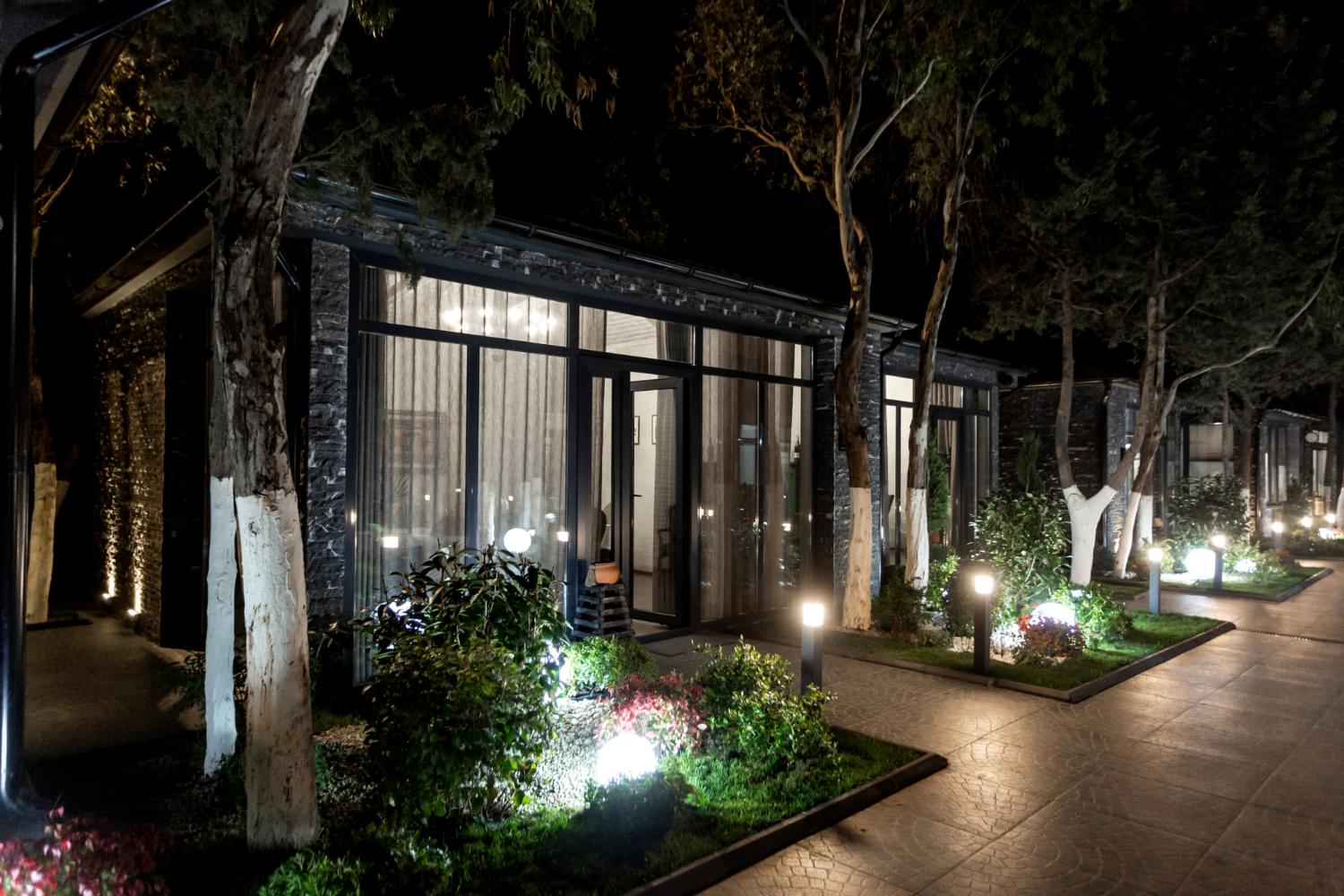
Safety and security. Well-lit steps, pathways, and entries reduce the risk of trips and falls, particularly during Ottawa’s long autumn evenings when guests may be navigating unfamiliar terrain in low light. A property that is visibly occupied and maintained after dark also discourages opportunistic intrusion. Timers, dusk-to-dawn sensors, and smart controls mean the system works consistently without requiring daily attention.
-
Ambiance and livability. Warm, low-angle light directed away from eyes creates enclosure and calm. It is the quality that makes people want to stay outside rather than retreat indoors when the temperature drops in September. The goal is to bring the comfort of a well-designed interior space into the garden not to flood the yard with brightness.
-
Architectural definition. Light reveals form in ways that daylight often obscures. The texture of a dry-stack stone wall, the structure of a mature tree canopy, the geometry of a pergola or garden gate all of these become more legible after dark when light is placed with intention. A property with strong architectural lighting at night often reads more clearly and more impressively than it does in the middle of the afternoon.
When all three are present, lighting stops feeling like a feature and starts feeling like a natural property of the space.
Types of Landscape Lighting and Where Each One Belongs
A complete lighting design draws from several fixture categories. Each has a distinct role, and the best schemes use them in combination rather than defaulting to a single type.
-
Path lighting: low-profile fixtures set along walkways, garden borders, and driveways. Effective path lights cast light downward and outward at grade level, marking movement routes without creating glare. They are unobtrusive during the day and functional at night without drawing attention to themselves.
-
Uplighting: fixtures set at or near grade level, aimed upward to illuminate vertical features: the face of the house, a garden wall, a mature tree, or a tall hedge. A single well-placed uplight beneath a specimen tree can anchor an entire garden composition after dark. Uplighting is also effective for highlighting natural stone or architectural features on the home’s exterior.
-
Step lighting: recessed into risers or set flush into adjacent retaining walls, step lights handle grade changes safely without requiring a separate post or stake fixture. They are a safety element and a design detail simultaneously, and they read particularly well on natural stone steps where the texture of the material catches the light.
-
Overhead and string lighting: It is used above outdoor dining or seating areas to create a canopy effect. In the context of a pergola or covered terrace, this type of lighting reinforces the sense of being in a defined outdoor room. It is one of the strongest ways to extend usable evening hours on a patio through September and October.
-
Feature lighting: Reserved for specific focal points: a water feature, a fire element, a piece of garden sculpture, or a section of particularly striking natural stone. Used sparingly, feature lighting gives the eye somewhere to land and creates hierarchy within the overall scheme. It is the element that separates a well-curated lighting design from a uniform spread of fixtures.
LED and Low Voltage Systems: The Practical Considerations
The majority of contemporary landscape lighting installations use low-voltage LED systems, and for Ottawa properties this is the right default choice. The reasons are practical rather than technical:
-
LED fixtures consume significantly less energy than older halogen technology, which matters when a system runs every evening from dusk to a scheduled off-time
-
Low heat output reduces stress on buried components through Ottawa’s temperature cycling, and lessens the risk of heat-related degradation in fixture housings
-
Service life is substantially longer than halogen an important consideration when fixtures are buried beneath hardscape or mounted in locations that are not straightforward to access for maintenance
Colour temperature options allow for warmer or cooler light output depending on the materials and mood you are designing for warm whites work well with natural stone and wood; slightly cooler temperatures suit contemporary architectural materials
Low-voltage systems operate at 12 volts through a transformer connected to a standard household circuit. Line-voltage systems at 120 volts are used in specific applications typically where higher lumen output is required or where fixtures are integrated directly into structural elements and these require a licensed electrician for installation.
All electrical work associated with landscape lighting must comply with the Ontario Electrical Safety Code. Depending on the scope of the project, an Electrical Safety Authority (ESA) permit may be required. We recommend confirming permit requirements with your contractor before work begins, as this varies based on the nature and extent of the installation.
Why Lighting Belongs in the Design Phase, Not the Finishing Phase
One of the most common and most costly mistakes in landscape lighting is treating it as a finishing layer something added after the hardscape is complete and the planting is in. The logic seems reasonable: see the finished space first, then decide what to light. In practice, it almost always produces a worse result at a higher cost.
The reason is straightforward: the most effective lighting schemes are invisible during the day. That invisibility requires planning from the start:
-
Conduit runs are routed beneath patios, pathways, and planted areas before surfaces are finished not cut through them afterward
-
Junction boxes are positioned at planned depths in planned locations, concealed within planting beds or behind stone rather than surface-mounted as an afterthought
-
Fixture positions are chosen in relation to the completed planting and hardscape design, not adapted around features that weren’t considered when the lighting plan was made
-
Wiring to overhead positions in pergolas or covered structures is run during framing, not surface-mounted after the fact
When we develop outdoor living spaces whether a new patio, a pergola and seating area, or a complete backyard transformation lighting is part of the conversation from the first site visit. We consider sun orientation, which views are worth framing after dark, how the space will be used on an October evening, and what the property should look like from the street at night. These considerations shape decisions about hardscape layout, planting placement, and structure design in ways that make the lighting design stronger and the overall result more coherent.
Retrofitting an existing landscape with lighting is always an option, but it involves cutting into finished surfaces, routing conduit around established plantings, and adapting to constraints that didn’t need to exist. If you are planning a new patio installation or any significant outdoor project in the coming season, including lighting in the original scope is almost always the cleaner and more cost-effective path.
What the Design and Installation Process Looks Like
For clients who are new to a professionally designed lighting project, the process typically follows this sequence:
-
Site assessment at dusk. We visit the property in low light to observe existing conditions, identify dark zones, understand the ambient light environment, and get a clear picture of what the property actually looks like after dark. This step is often skipped when lighting is treated as an add-on. It should not be.
-
Lighting plan. We develop a plan covering fixture types, placement, layering strategy, and control approach. Where lighting is part of a broader design-build project, the plan is integrated into the overall landscape drawings so that conduit and fixture positions are coordinated with hardscape and planting from the start.
-
Installation. Electrical work is carried out by a licensed electrician where required. Conduit and wiring are routed cleanly, finished surfaces are protected, and fixtures are mounted or set to specification.
-
Night-time commissioning. We return after dark to adjust aim, intensity, and beam spread on-site. No lighting plan survives first contact with the real space unchanged commissioning is where the design is refined into the final result.
-
Controls setup. Timers, dusk-to-dawn sensors, and any app-based scheduling are configured and explained. The system should run reliably without requiring ongoing attention.
Ready to Talk About Your Property?
Ottawa’s outdoor season is short enough without giving up the evenings. Whether you have a specific project in mind or are simply beginning to think through what your property could look like after dark, we would be glad to have that conversation.
We work with a limited number of clients each season, and the projects that come together most successfully are the ones where planning begins early. If you are considering outdoor work for this season or the next, reaching out now is worthwhile.
Get in touch to start the conversation. There is no obligation, and earlier is always better.