
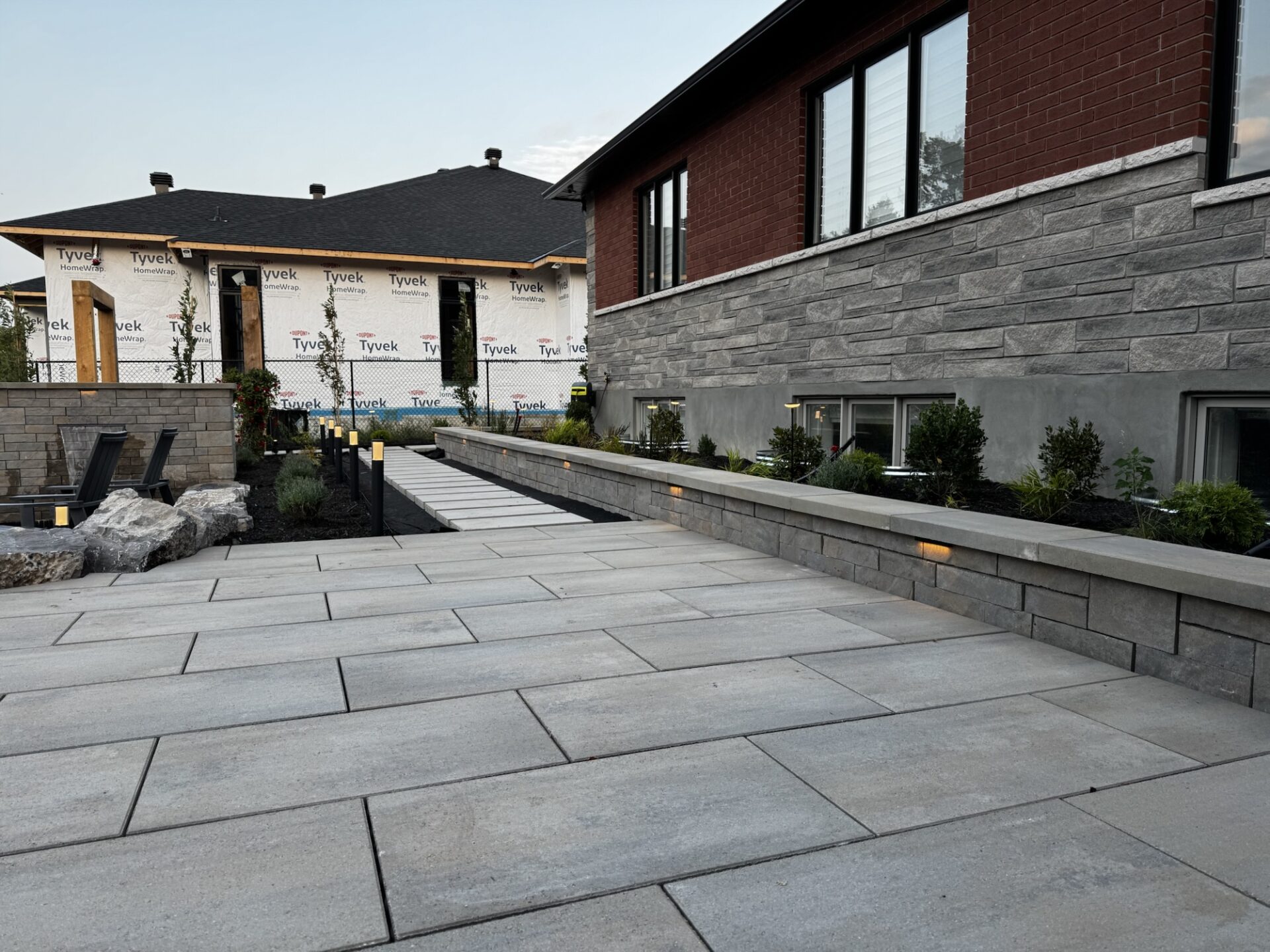
There is a particular moment in an Ottawa autumn usually the first week of September when the evening temperature drops sharply enough that the instinct to go inside becomes hard to resist. The days are still long enough to justify the patio furniture, but by seven o’clock the chill has arrived, and the outdoor space that took real thought and money to build sits empty for another night.
A fire feature changes that. A well-placed fire pit or outdoor fireplace can recover four to six weeks of outdoor living that Ottawa’s climate would otherwise take away pushing the usable season into October and making September evenings feel like an extension of summer rather than its quiet end.
The question we hear most often isn’t whether to add a fire feature. It’s which one. Fire pit or outdoor fireplace? The answer depends on how you use your outdoor space, what your property can support, and what role you want the feature to play in the overall design. We’ll walk through the real trade-offs honestly.
What Each Feature Actually Is (and What It Isn’t)
A fire pit whether sunk into the ground, raised above grade, or freestanding is an open, 360-degree heat source. Seating wraps around it on all sides. It works across a range of yard sizes, feels inherently social and informal, and comes in wood-burning or gas variants in materials from natural stone to weathering steel. What it isn’t is a strong architectural element: a fire pit gives you warmth and ambience, but it doesn’t define or enclose a space the way a built structure does.
An outdoor fireplace is different in kind, not just scale. It’s a masonry or stone structure with a firebox, flue, and chimney. It functions architecturally as well as thermally creating a back wall, drawing the eye, and giving an outdoor room a sense of permanence. It pairs naturally with covered structures like pergolas and tends to anchor more formal outdoor living areas. The trade-off is flexibility: once an outdoor fireplace is built, it defines the space around it. That’s an asset when the design is right, and a constraint when it isn’t.
How Each One Performs in Ottawa’s Climate
Ottawa’s freeze-thaw cycle typically 50 to 70 cycles per year is the detail that separates adequate installation from durable installation. Any structure on an inadequate base will move, crack, and fail over time. This applies to both fire features, but it matters more for outdoor fireplaces, which carry significantly more weight and are more sensitive to foundation movement.
A properly installed fire pit requires a compacted, frost-resistant base. An outdoor fireplace requires a poured concrete footing, engineered to depth in most cases. Ontario Building Code sets out specific requirements for clearances from combustibles, footing specifications, and chimney height relative to surrounding structures. These aren’t optional they’re what determines whether a feature holds for decades or becomes a problem in five years.
The Design Considerations: Space, Sight Lines, and Seating
The most common mistake we see with fire features isn’t technical. It’s proportional. A large outdoor fireplace on a compact urban lot in Westboro reads as imposing and closes down the space. The same fireplace on a larger Manotick or Kanata Lakes property, integrated into a covered outdoor room, feels entirely natural. Scale matters more than almost any other variable.
Fire pits are genuinely flexible across lot sizes. A 90-centimetre round pit with a low stone surround can work in a modest backyard without overwhelming it, and the social dynamic is different from a fireplace: conversation flows across the circle rather than facing one wall.
This is why we believe fire features should be part of the landscape design from the beginning, not inserted into an existing patio after the fact. The stone, the interlock, the natural paving should carry through from the broader design to the feature itself. A fire feature that arrives late to the plan always reads like it did.
Permits and City of Ottawa Requirements
Wood-burning fire pits are subject to City of Ottawa open-air burning bylaws, which can restrict or prohibit use during certain conditions or periods. These regulations change seasonally and are enforced at the municipal level. Before committing to a wood-burning feature, verify the current rules directly with the City what applied last season may not apply this one.
Natural gas and propane features carry fewer day-to-day restrictions, but permits are still required. For gas, that means:
- A building permit for the gas line extension
- Inspections under the Ontario Building Code
- Clear communication from your contractor about timeline and cost before any work begins
Outdoor fireplaces face the most detailed requirements, including:
- Clearances from combustible materials
- Engineered concrete footings
- Chimney height specifications relative to adjacent structures
- Possible structural engineering review, and heritage or zoning overlays in areas like Rockcliffe Park or Manotick
We handle these requirements as part of every fire feature project. It’s not something to work out after the fact.
Which One Fits Your Property and How You Use It
The honest answer is that both features are right for different situations. A fire pit suits homeowners who want social flexibility, work with a smaller yard, and prefer something casual and gathering-focused. An outdoor fireplace suits homeowners who want a defining architectural element, have the space to support it, and are building out a more complete outdoor room.
What drives the decision most, in our experience, isn’t budget or aesthetics. It’s how the homeowner actually uses their outdoor space. A family that hosts large, informal gatherings will get more from a fire pit. A couple who wants a quiet, enclosed outdoor room for shoulder-season evenings will get more from a fireplace. Neither is a mistake when the design supports the intention
How Fire Features Integrate into a Full Landscape Design
A fire feature works best as one considered element within a larger outdoor space not the single focal point that everything else is rearranged around after the fact. The projects we’re most proud of are the ones where the fire feature, the patio design, and the broader site plan were conceived together, so the materials, the levels, the sight lines, and the seating all feel like they belong to each other.
In Manotick and Kanata Lakes, where larger lots support more elaborate outdoor programs, fire features often anchor a sequence of spaces dining, lounge, fire connected by consistent hardscape and thoughtful planting. In Westboro and similar urban neighbourhoods, the challenge is doing more with less: choosing a feature that gives the yard a genuine focal point without closing it down.
A fire feature built as part of a cohesive outdoor living design will age well alongside the space around it. One that arrived late to the plan will always look like it did.
The right fire feature depends on specifics we can’t assess without understanding your property its size, its relationship to the home, how you use it, and what you’re trying to accomplish over the longer term. If this has raised questions you’d like to work through, we’re glad to talk.
WLS takes on a limited number of projects each season, which means we’re able to stay genuinely involved from design through to the final day of construction. If the timing is right, we’d like to hear about your project. Start a conversation here.