
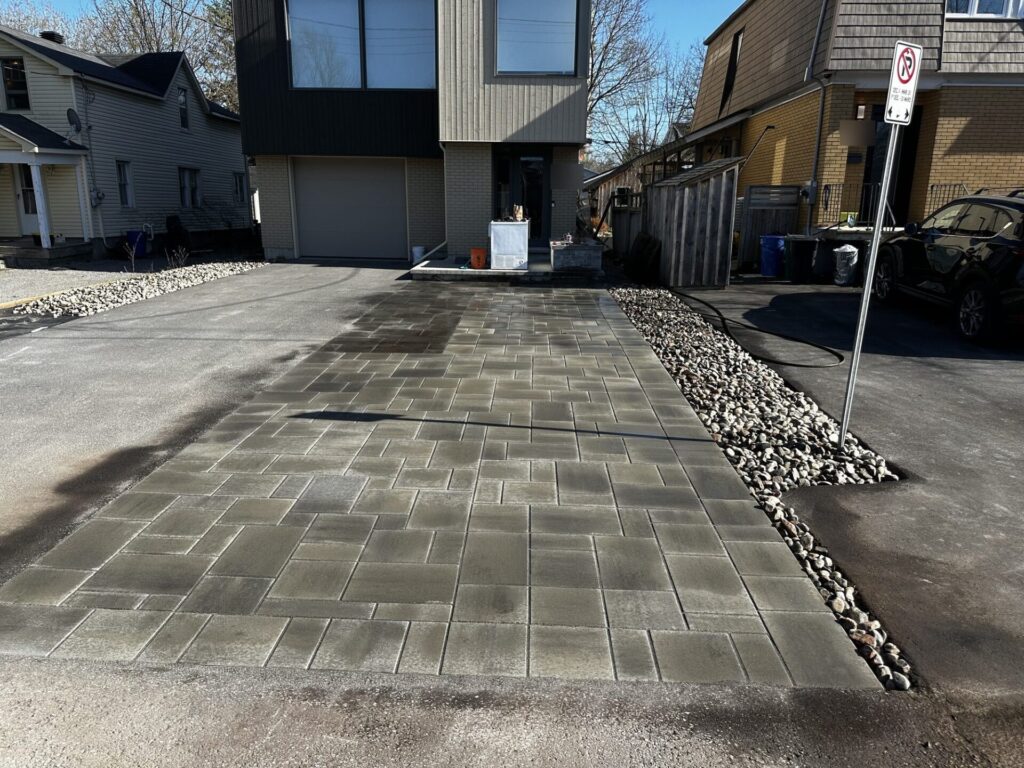
After “what’s a patio going to cost?”, the next question we hear most is about driveways. It’s a bigger surface, it carries a car every day, and in Ottawa it spends half the year freezing and thawing. That changes the price, and it changes what you should be paying for.
Here’s what published Ottawa numbers say, where the money goes, and what to check before anyone starts digging.
The short answer: interlock driveway prices in Ottawa in 2026
Ottawa contractors who publish their pricing land in a similar range for an interlock driveway on a new base:
- Most driveways: about $20 to $30 a square foot, installed.
- The full spread: about $15 to $40 a square foot, from reusing a sound existing base with standard pavers up to premium pavers, borders and detailed patterns.
- Widening an existing driveway by a few feet: often about $2,000 to $6,500.
A typical double driveway runs 500 to 800 square feet, so at the common range that’s roughly $10,000 to $24,000. Taking out the old asphalt or concrete is usually priced on top.
For comparison, the same sources put asphalt at about $5 to $10 a square foot and poured concrete at about $10 to $18. Interlock costs more up front. What you get for it is a surface you can repair one paver at a time, and one that moves with the frost instead of cracking.
Those are published ranges from other Ottawa companies, not our price list. Most of our projects are bigger builds that start around $25,000, and a driveway is often one part of a full front yard with a walkway, steps and planting.
Where the money goes
The base
A patio carries people. A driveway carries a two-tonne vehicle turning its wheels on the same spot every morning, on clay that heaves when it freezes. The base is what stops ruts and sinking, and it’s where most of the cost is.
Published Ottawa guides talk about digging 10 to 12 inches for a driveway. We dig ours out about 18 inches and rebuild it in compacted layers of granular stone, because on Ottawa clay the extra depth is what keeps it flat. A heated driveway goes deeper again to make room for the system. Whatever depth a contractor uses, it should be written in their proposal.
The pavers
Driveway pavers need to be thicker than patio pavers, at least 80 mm, to handle the weight. Standard concrete pavers from makers like Techo-Bloc, Permacon and Unilock sit at the lower end. Larger formats, premium textures and natural-look finishes cost more to buy and to lay.
Pattern, borders and cuts
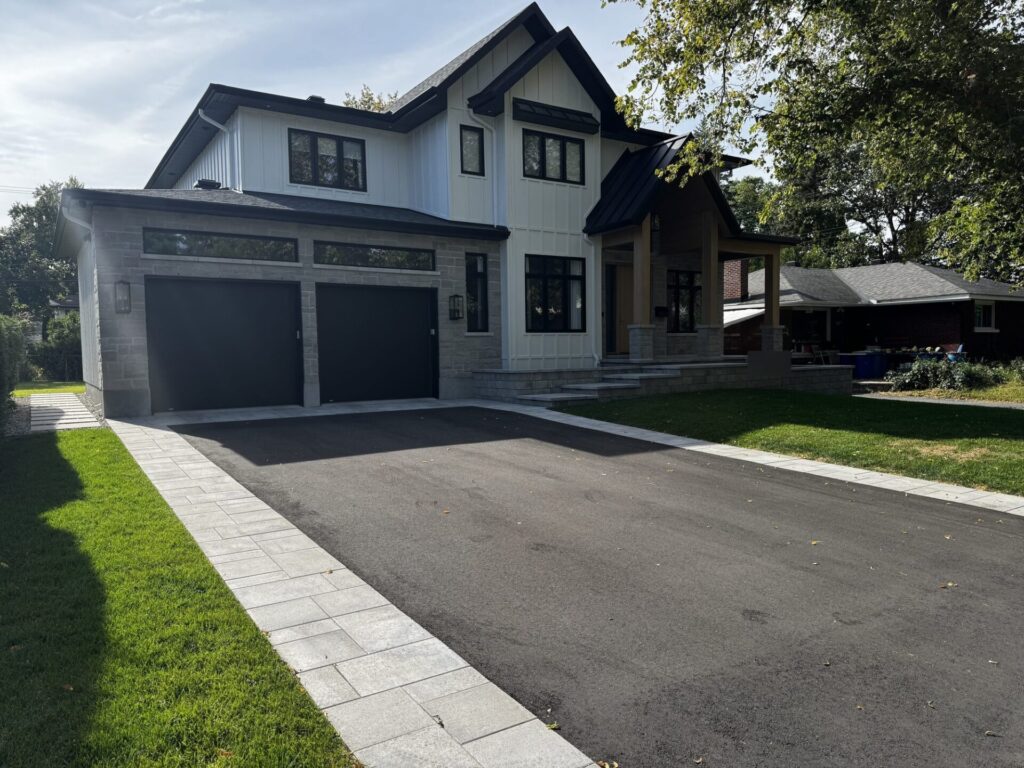
Herringbone is the strongest pattern for a driveway because the pavers lock against each other in every direction. Borders, bands and curves add cutting and time. They’re worth it on a lot of homes. They’re also part of why two driveways the same size can be thousands of dollars apart.
Removal, grading and drainage
Breaking out old asphalt or concrete, trucking it away and fixing the grade so water runs away from the garage and the house all add to the price. Skip the grading and you’ll be chasing ice on the driveway every February.
Access and timing
Most driveways are easy for machines to reach, which helps. What adds cost is a tight lot, a steep slope, or a driveway that has to stay usable during the build.
The City permit, if you’re widening or changing the entrance
The part of your driveway between the sidewalk or road and your property line sits in the City’s right of way. Under the City of Ottawa’s Access By-law (No. 2026-139), which replaced the old Private Approach By-law in April 2026, you need an access permit to build, modify, widen, close or remove that part of a driveway. The rules cover the total width, the distance from your neighbour’s property line, the slope and how it’s built. The City’s access permits for driveways and walkways page has the details.
Anyone who installs or alters a driveway or other hard landscaping in Ottawa also has to hold a City hardscaping contractor licence. We explain what that licence covers in our post on Ottawa’s hardscaping contractor rules.
What a good driveway proposal should spell out
- removal of the old surface, and where it goes
- excavation depth and the base materials, in writing
- the paver product, thickness, colour and pattern
- edge restraint, and the joint sand
- grading and drainage away from the house and garage
- who applies for the City access permit, if one’s needed
- repairs to the lawn and gardens beside the driveway, and the warranty
If two prices are far apart, the base is almost always the reason. Ask both contractors how deep they dig and what goes back in.
Materials and patterns
If you’re still choosing the look, our guide to driveway interlock materials and patterns in Ottawa covers paver types, colours and layouts in more detail.
Pricing your driveway
Our own crews build every driveway we design, and our pavers and walls carry a 3-year warranty. You can see more of our interlock driveway work in Ottawa, and when you’re ready, book a site visit with us. We’ll check the base, the grade and the City rules for your address, then give you a written price.
Frequently asked questions
How much does an interlock driveway cost in Ottawa?
Published Ottawa pricing puts most interlock driveways on a new base at about $20 to $30 a square foot, with the full range running from about $15 to $40. A double driveway of 500 to 800 square feet usually lands around $10,000 to $24,000, before removing the old surface.
Is interlock worth it over asphalt in Ottawa?
Asphalt costs less up front, but it cracks with the frost and needs sealing and patching. A well-built interlock driveway flexes with freeze-thaw, and if a section settles, it can be lifted and relaid without tearing out the whole driveway.
Do I need a permit to redo my driveway in Ottawa?
You need a City access permit to build, modify, widen, close or remove the part of the driveway in the City’s right of way, between the road or sidewalk and your property line. Check the City’s Access By-law rules before you plan a wider driveway.
How deep should a driveway base be in Ottawa?
Published Ottawa guides talk about 10 to 12 inches. We dig ours out about 18 inches on clay soil. Either way, the depth and base materials should be written into the proposal.
How long does an interlock driveway take to install?
Once the old surface is out, most residential driveways take a few days to a week, depending on size, pattern and weather. Interlock is installed from spring through late fall, once the ground has thawed.